
Moving a Hot Tub in Colorado: Cost & What It Takes
A hot tub is one of the hardest things you can try to move, and in Colorado the usual challenges get harder. If you’re weighing a DIY hot tub move against hiring pros, the honest answer is that a spa is heavy, awkward, fragile in exactly the wrong places, and unforgiving of a single bad angle on a stairway or slope. This guide walks through what it actually costs to move a hot tub, the access and equipment a safe move requires, and why so many do-it-yourself attempts end in a cracked shell, a wrenched back, or a voided warranty.
If you’ve already decided the job is bigger than a few friends and a rented dolly, that instinct is usually right. Here’s what to know either way.
Why a hot tub is harder to move than it looks
Most people underestimate a hot tub on three fronts at once.
Weight. Even fully drained, a hot tub is heavy and, more importantly, the weight isn’t evenly distributed – the cabinet, shell, pumps, and frame concentrate mass in ways that make it want to tip.
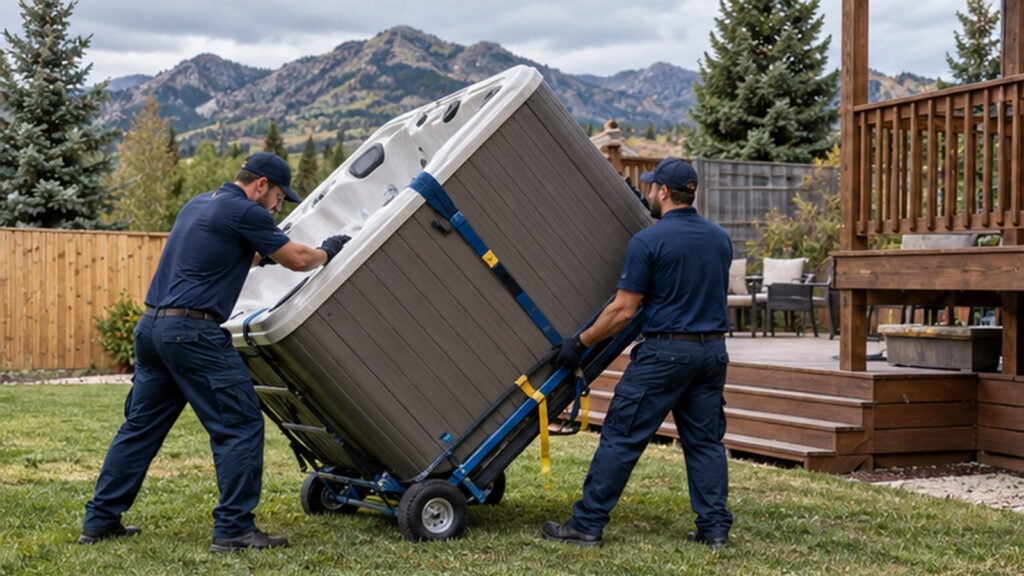
Balance and shape. A spa is a big, rigid, oddly shaped box with no good handholds. It has to be tilted onto its side and kept there to fit through gates and around corners, and controlling that tilt on anything but flat ground takes practice and the right straps.
Fragility. The acrylic shell and the plumbing underneath don’t tolerate flexing or point-loading. Set a tub down wrong, drag it, or let a corner take the full weight and you can crack the shell or damage the lines – often invisibly until you fill it again.
What it actually costs to move a hot tub
There’s no single price for moving a hot tub, because the cost tracks the difficulty of your specific move. The factors that move the number most:
- Distance – a reposition in the same yard versus a cross-town or long-distance haul.
- Access – a straight shot across flat ground is cheap; stairs, tight gates, slopes, and long carries add labor and equipment.
- Crew size and equipment – the number of movers and whether the job needs specialty dollies, ramps, or a crane for an over-the-fence or rooftop-deck situation.
- Disconnection and reconnection – whether electrical and plumbing need to be handled by the appropriate trade before and after.
The takeaway: get a quote based on your actual layout, not a ballpark from a forum. A mover who asks about your gate width, deck height, and driveway slope is pricing it correctly.
Access and equipment: the part DIY movers forget
Nearly every failed hot tub move comes down to access. Before anyone lifts anything, the path has to be measured and cleared:
- Doorways and gates – a tub on its side still needs clearance; measure the narrowest point on the route.
- Stairs and slopes – the most dangerous part of the move, where a tub can get away from an under-equipped crew.
- Turns and landings – tight corners often decide whether the tub fits at all.
- The set-down – a level, prepared spot on the other end so the tub isn’t resting on an edge.
The equipment gap is just as real. Proper hot tub moves use heavy-duty straps, spa dollies or specialty carts, ramps, and – for genuinely inaccessible spots – a crane. Rounding up furniture dollies and muscle is exactly how shells get cracked and people get hurt.
For the broader picture of how professional crews approach oversized, awkward loads, see how movers safely handle heavy and oversized items.
Colorado-specific challenges
A Colorado hot tub move adds a few wrinkles you won’t find in a flat, mild climate:
- Mountain and hillside properties – homes in areas like Monument, Black Forest, and the foothills often have steep driveways, tiered decks, and tight access that turn a routine move into a rigging job.
- Snow and ice – a slick surface under a heavy, tilting load is a serious hazard; timing and traction matter.
- Elevation and terrain – long carries over uneven ground are more common here than in a typical suburban lot.
These are exactly the conditions where local experience pays off. Fatboy Slims Moving handles spa and specialty moves across the region through our heavy item moving service, including tight-access properties in communities like Monument.
DIY vs. hiring pros: how the math really works
DIY looks cheaper until you price in what can go wrong. A cracked acrylic shell, damaged plumbing, a manufacturer warranty voided by improper handling, or an injury from a load that shifts on a slope can each cost far more than a professional move would have. The savings on a DIY hot tub move are real only if nothing goes wrong – and the odds of nothing going wrong are lower than most people expect.
Hiring pros makes the most sense when there are stairs or slopes on the route, tight gate or deck access, any distance beyond a simple reposition, or a tub still worth protecting. If the move is a few feet across level ground with a full crew and the right dolly, DIY can work. Past that, the professional route is usually the cheaper one once risk is priced in.
Frequently asked questions
How much does it cost to move a hot tub?
It depends on distance, access, crew size, and whether disconnection and reconnection are needed. A simple reposition costs far less than a move involving stairs, slopes, tight access, or long-distance transport – so the accurate number comes from a quote based on your specific layout.
Can you move a hot tub on its side?
Yes – most hot tubs are moved tilted onto their side to fit through gates and around corners, secured with heavy-duty straps on a spa dolly. It has to be done carefully to avoid stressing the shell or plumbing.
Do movers disconnect and reconnect hot tubs?
Electrical and plumbing connections should be handled by the appropriate trade. A moving crew coordinates the physical move; confirm up front who is handling the disconnect and reconnect so nothing is left to chance on the day.
How many people does it take to move a hot tub?
More than most DIY attempts bring. A safe move uses a trained crew sized to the tub and the access – not a couple of helpers and a standard dolly – because the danger is in controlling weight and balance on stairs, slopes, and turns.
Moving a hot tub? Let a specialty crew handle it
A hot tub move is one of the few jobs where doing it yourself can cost more than hiring out, once a cracked shell, a voided warranty, or an injury enters the picture. If your move involves stairs, slopes, tight access, or any real distance, it’s worth bringing in a crew with the right equipment. Get a moving estimate from Fatboy Slims Moving and have your spa moved without the gamble.